
FOR ORGANIZATIONS

Organizational
CONSCIOUSNESS
An organization can only make decisions against what it is capable of seeing.

Maison Djordje examines the architecture producing an organization’s operating reality—what shapes its decisions, directs its behavior and determines the consequences that follow.
Greater resolution changes what becomes possible to decide.
Organizations
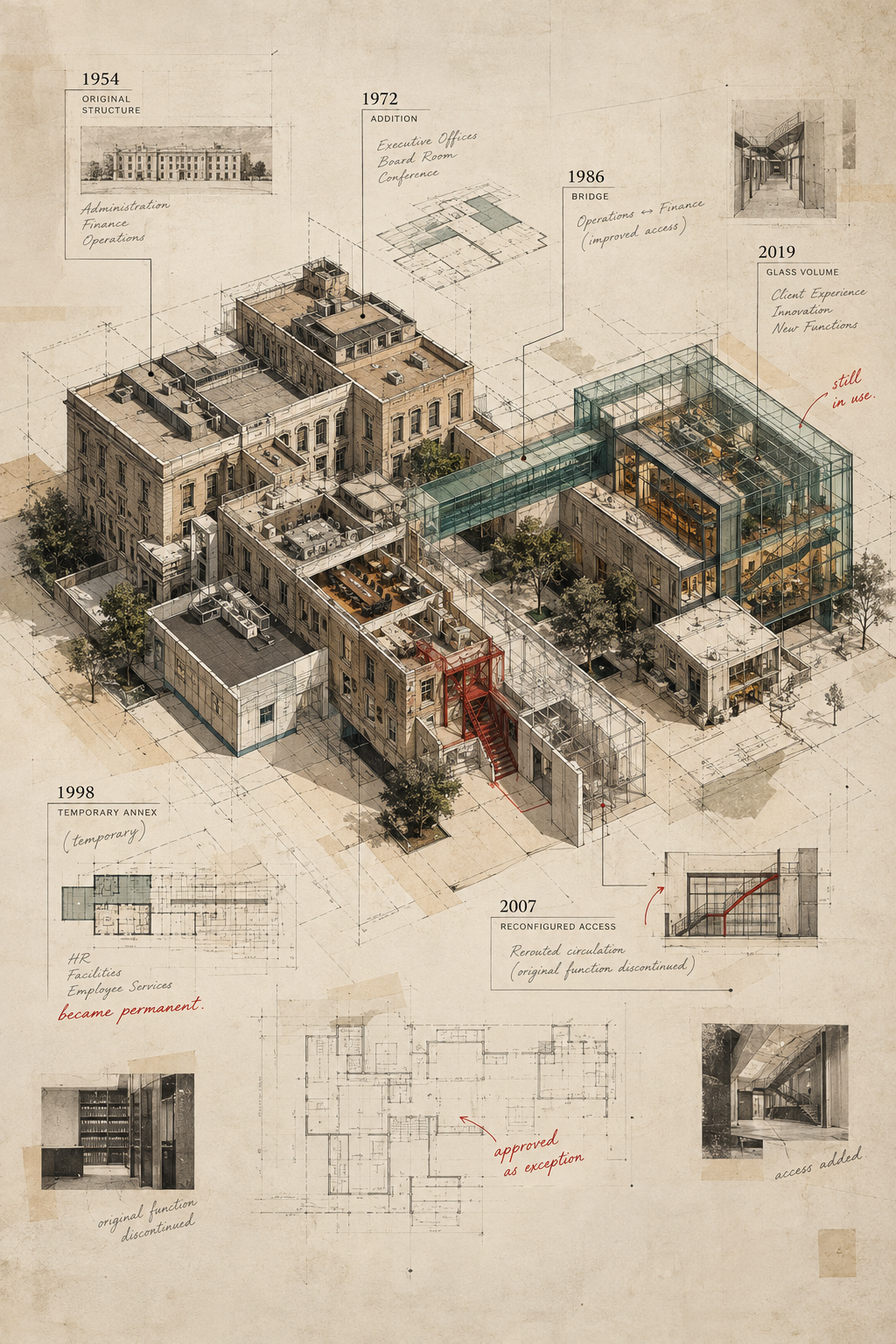
accumulate ARCHITECTURE.
Some are deliberate. Others emerge in response to circumstance—a workaround that becomes routine, an exception that becomes expectation, a behavior rewarded often enough to become culture.
Over time, these decisions become condition
Every organization
is made of
decisions.
They shape where authority lives, how information moves, what gets protected, what becomes difficult and what people learn to do in order to make the organization work.
Eventually, what was arranged can begin to feel inevitable.
That is where resolution matters.
Because some of what an organization experiences as reality may instead be the consequence of its own architecture.
What has been arranged can be examined. What can be examined can be decided again.
ORGANIZATIONAL CONSCIOUSNESS

Intelligence is not the same as
consciousness.
An organization can possess exceptional people, sophisticated data,
experienced leadership and considerable institutional knowledge
—and
still have limited resolution of itself.
The people best positioned to understand an organization are also participating in it.
They inherit its explanations. Adapt to its conditions. Learn which routes work, which decisions move, what can be questioned and what is simply understood to be
how things are done here.
Organizational consciousness
is the capacity to perceive those conditions with enough resolution to distinguish what is necessary from what has become familiar
—and to understand the consequences of both.
This is Maison’s discipline.
We examine an organization as architecture: locating where consequence is being produced, tracing it through the structures and decisions that produce it, and distinguishing what is fixed from what has merely become established.
We make the operating architecture legible enough to act on.
03/ THE FIELD
Consequence rarely respects the org chart.
Organizations divide themselves into functions. Their architecture does not operate so neatly. A customer experience may be shaped by a finance decision. A communication failure may begin with authority. An operational workaround may be compensating for an incentive no one thought to examine.
Maison follows the consequence backward.
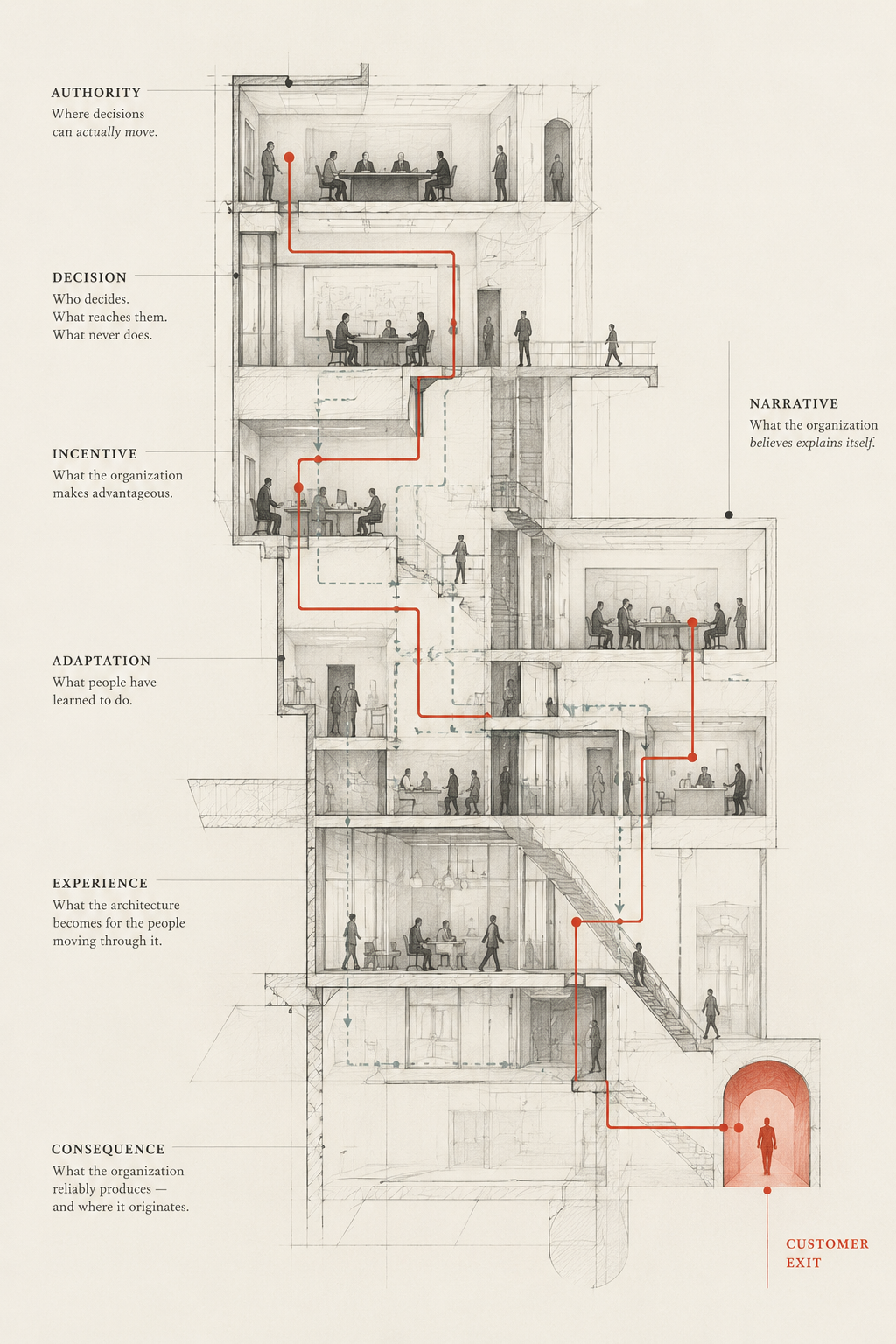
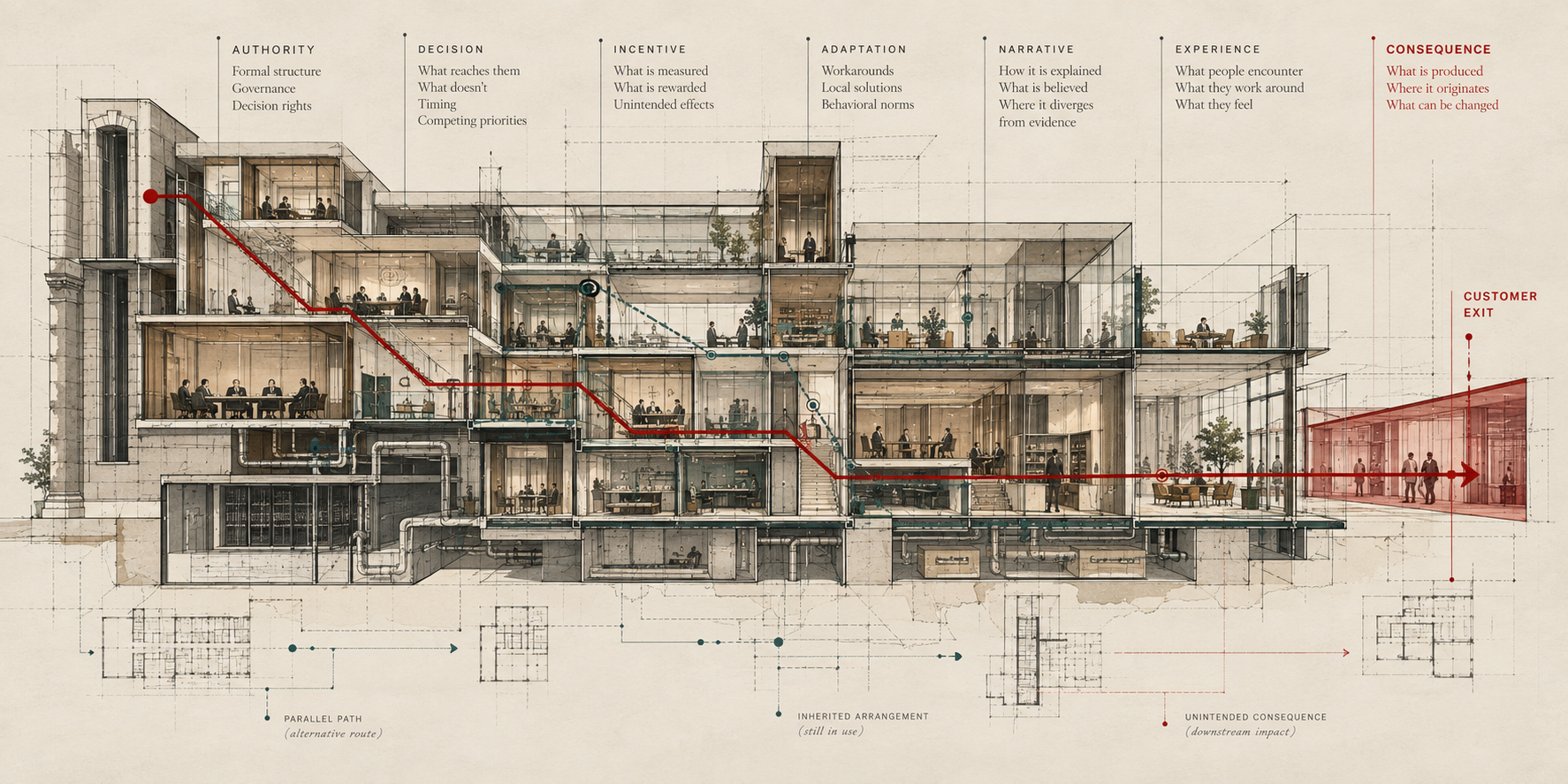
—— We trace what is being produced through the decisions, structures, behaviors and adaptations that made it possible—across functions, reporting lines and inherited explanations.
01 AUTHORITY——
Where authority formally sits.
Where decisions can actually move.
02 DECISIONS——
Who decides. What reaches them.
What never does.
03 INCENTIVE——
What is said to matter.
What the organization makes advantageous.
04 ADAPTATION ——
What people have learned to do
to make the existing architecture work.
05 NARRATIVE ——
What the organization believes explains itself.
Where the explanation and evidence diverge.
06 EXPERIENCE ——
What the architecture becomes
for the people moving through it.
07 CONSEQUENCE ——
What the organization reliably produces—and where it originates.

Consequence
has ARCHITECTURE
Maison
traces it to its source.
04 / THE ENGAGEMENT
We do not begin with an answer.
Maison enters an organization to establish its architecture at sufficient resolution to act upon.
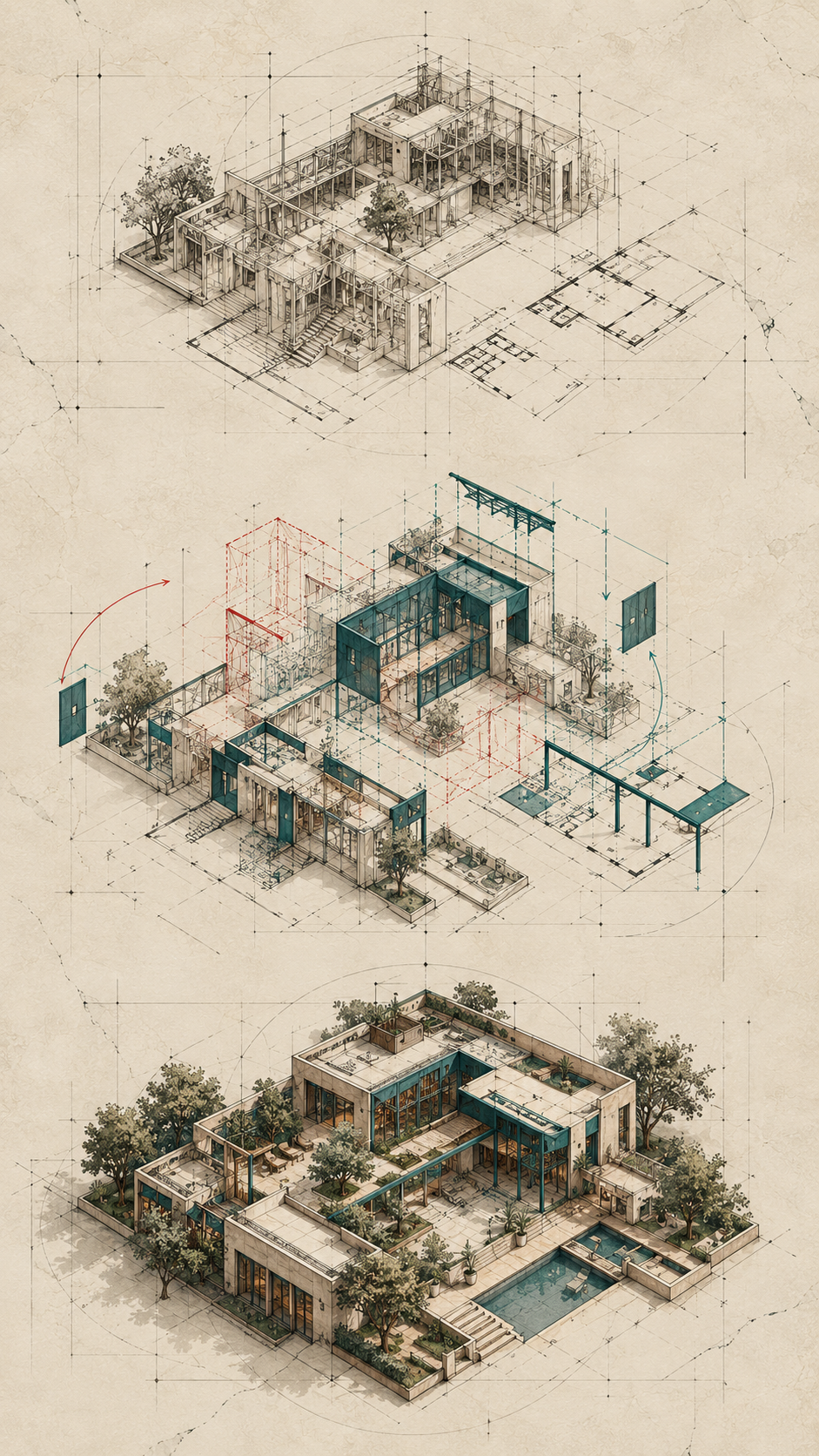
The engagement proceeds in three phases. Each has a distinct purpose. Each produces new information that determines what the work requires next.
0I — THE EXAMINATION
We establish the existing condition.
Maison observes the structures, decisions, relationships and adaptations relevant to the matter under examination—then traces how they interact and what they produce.
The Examination establishes what is true enough to act upon.
02 — THE DEVELOPMENT
We work on the architecture.
Where change is warranted, Maison works with the organization to alter the conditions producing consequence—making decisions, developing new arrangements and observing what those changes produce in practice.
Development is not the implementation of a predetermined answer. The architecture continues to inform the work.
III — THE REVELATION
We examine what the changed architecture reveals.
What moved. What held. What emerged. What became newly possible. And what can now be seen from a position the organization did not previously occupy.
The organization does not leave with a theory of what changed. It leaves having observed what the change produced.
RECORDS
The work leaves evidence.
Maison does not ask an organization to rely on memory for what it has seen.
Throughout an engagement, observation is resolved into a series of Prints—material records of the architecture encountered, the consequences identified, the decisions made and what develops as conditions change.
The first Examination closes with The First Print.
As the work develops, subsequent Prints document what has moved, what has held, what has emerged and what requires further attention.
Together, they become The Record: an accumulated account of the organization across the engagement.
At the close of Revelation, Maison produces The Revealed—the final articulation of what the organization has become capable of seeing from its new position.
The work changes. The evidence remains.
At the close of Revelation, Maison produces The Revealed—the final articulation of what the organization has become capable of seeing from its new position.
The work changes. The evidence remains.
The first Examination closes with The First Print.
As the work develops, subsequent Prints document what has moved, what has held, what has emerged and what requires further attention.
Together, they become The Record: an accumulated account of the organization across the engagement.
THE BRIEF
For organizations considering an engagement with Maison Djordje.
The Brief outlines the practice in greater detail, including engagement architecture, participation requirements, phasing, economics and the application process.
Request The Brief →
Small institutional notation:
Requests are received and delivered by the Steward.
And perhaps only here, after requesting The Brief, do we mention:
Applications require a $7,500 non-refundable submission fee.